Auto parts automation
A VIN or OEM request becomes a reply with matching parts
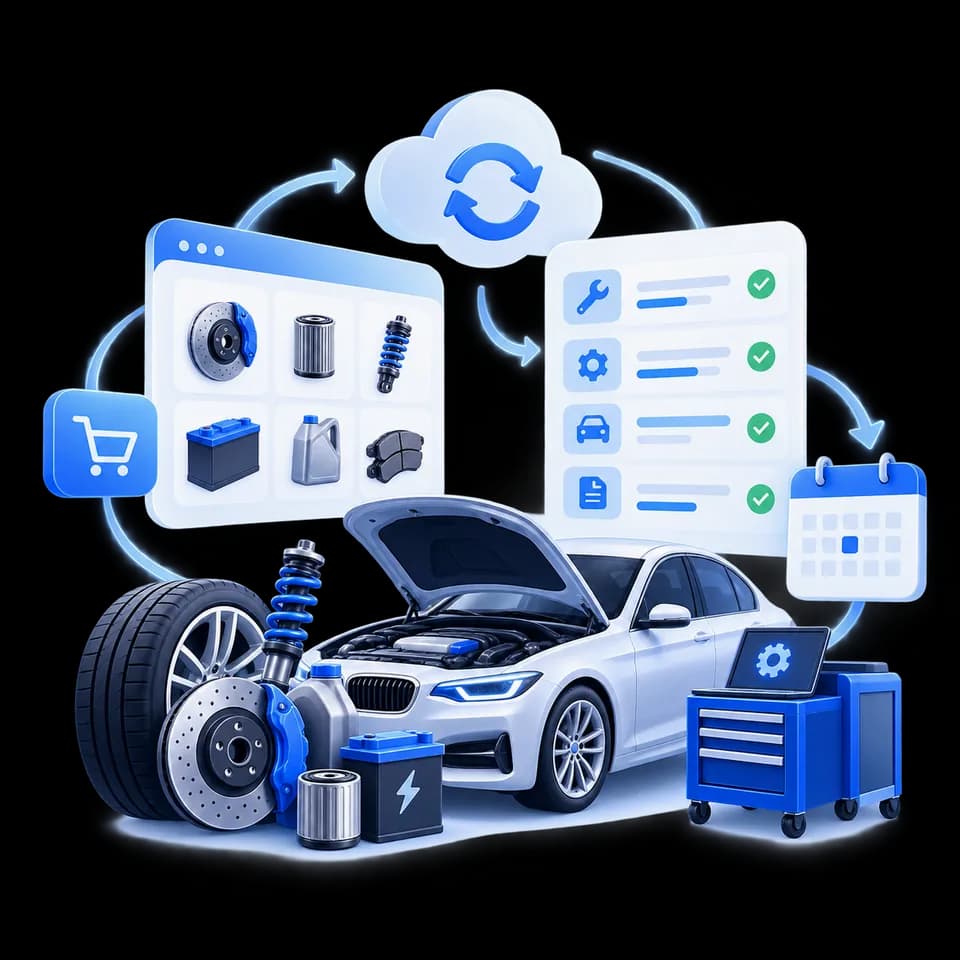
The system reads the customer’s request, recognises the VIN or OEM part number, finds matching parts in your catalogue, checks prices and stock and prepares a draft reply.
Your sales team reviews and sends the reply.
- 30–45 minute call
- examples shown on your own screen
- written assessment afterwards
- Vehicle recognised
- Parts found in catalogue
- Stock checked
Processes
Parts and service work the system can take over
- Requests with a VINvehicle details and matching parts
- OEM and cross-reference numberschecked against your catalogue
- Price and stock questionsreply with data from your systems
- Confirmed ordersorder in the ERP or warehouse system
- Service bookingscalendar entry and a reminder to the customer
- Unclear casesa task for your sales team with all the details
How it works
From request to reply
Request arrives
Email, website form or message
Recognition
VIN, OEM number, vehicle details
Search
Your catalogue, cross-references, prices and stock
Draft reply
Matching parts with prices
Sales team approves
A reply goes out only after approval
The model reads the request, your catalogue and rules pick the parts, and a person approves the reply. Every choice is stored, so similar requests are assessed with the same logic.
Your software
Your catalogue and systems stay
The system works with your product catalogue, ERP or warehouse software and email through their APIs or import. Your sales team keeps working where it always has.
We use business-grade APIs that don’t train models on your data, and for sensitive processes the system can run on your own or an EU server. Data processing is agreed in the contract.
- Product catalogue
- ERP
- Warehouse system
- CRM
Who it’s for
When it makes economic sense
For parts retailers and service companies whose sales teams spend a lot of time looking up parts by VIN and answering similar requests.
Economics decide: the value recovered in a year has to clearly exceed the cost of the system.
If your catalogue data isn’t enough for accurate matching, we’ll say so during the process review.
Questions
What to know about VIN request automation
- How does the system match parts to a VIN?
- It extracts the VIN or OEM number from the request, identifies the vehicle and looks for matching parts and alternatives in your catalogue. Accuracy depends on your catalogue data, which we assess during the process review.
- Are replies sent to customers automatically?
- No. The system prepares a draft reply with parts, prices and stock, and your sales team reviews and sends it.
- Do we need to replace our catalogue or ERP?
- No. The system uses your product catalogue, ERP and warehouse system through their API or import.
- Where do we start, and what does it cost?
- We start with a 30–45 minute process review: you show a few typical requests on your screen and get a written assessment. The price is fixed after the review and proposal, and the first working phase is usually planned for 6–10 weeks.
- Is our data used to train AI models?
- No. We use business-grade APIs that don’t train models on your data. For sensitive processes the system can run on your own or an EU server, and data processing is agreed in the contract.
Contact
Show us how your team answers parts requests today
In a 30–45 minute call we look at a few typical requests on your screen. Afterwards we tell you in writing what can be automated, where rules are needed and whether the economics make sense.
Email
info@aiprocesai.ltPhone
+370 632 36434Location
Lithuania